
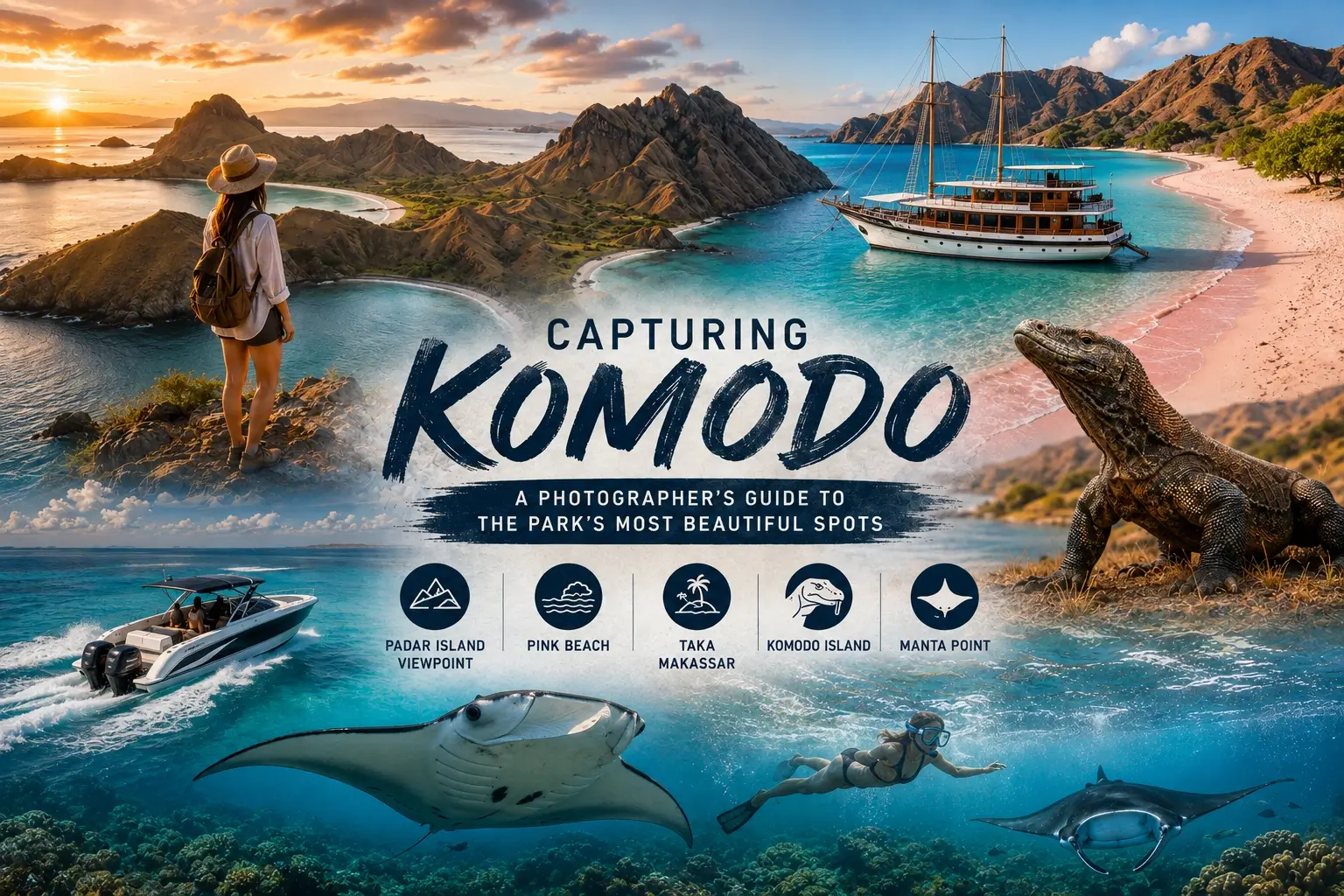
Capturing Komodo: A Photographer's Guide to the Park's Most Beautiful Spots
Komodo National Park is the kind of destination where you may find yourself reaching for your camera every few minutes — and honestly, we wouldn’t blame you. One moment you’re gazing across rugged savannah hills that seem to stretch into eternity, and the next you’re standing beside turquoise water so clear it looks like liquid glass, pink sand that feels like something from a dream, or a Komodo dragon moving through its ancient habitat with quiet, prehistoric grace.
The park lies between Sumbawa and Flores, bringing together several islands, coastal landscapes, wildlife habitats, and marine environments within one protected area. If photography is part of the reason you’re visiting — and let’s be honest, how could it not be? — these are some of the best photography spots in Komodo National Park to include in your journey. Grab your camera, charge those batteries, and let’s go chase some light.
1. Padar Island Viewpoint — The One You've Seen a Thousand Times (and It's Even Better in Person)
It’s difficult to start anywhere else. Padar Island is famous for its elevated viewpoint overlooking curved bays separated by dramatic ridgelines — the kind of view that makes you forget to breathe for a second. From the top, you can see beaches with different colored sand, surrounded by blue water and rolling hills that seem to fold into each other like waves frozen in time.
Photography tip: A wide-angle lens works beautifully here because the scale of the landscape is part of what makes Padar special. But don’t forget to include the trail or another traveler in the foreground — it gives your photograph more depth and helps tell the story of being there.
Here’s a little secret: take your time once you reach the viewpoint. The first rush of people will eventually thin out. Sometimes the best photograph appears after the first crowd has already taken theirs and moved on. Wait for that quiet moment. It’s worth it.
2. Pink Beach — Where the Sand Blushes
After photographing Komodo from above, it’s time to get closer to the coastline. Pink Beach gives photographers a completely different color palette — soft pink shoreline that creates a beautiful contrast against clear turquoise water and the rugged hills behind it. It’s the kind of place that makes you question whether your eyes are playing tricks on you.
Photography tip: Try photographing from close to the water rather than only taking a wide landscape shot. The meeting point between the pink sand and incoming waves can create interesting textures — patterns that feel almost abstract. Get low, let the water wash over the sand, and capture that perfect moment where land and sea embrace.
And yes, your phone camera is perfectly capable of capturing it too. Good natural light often matters more than carrying the biggest camera. The sun does most of the work here — you just need to show up.
3. Taka Makassar — Simplicity at Its Most Beautiful
Sometimes simplicity makes the strongest photograph. Taka Makassar is a tiny sandbank surrounded by shallow, bright turquoise water — so small it feels like the ocean just decided to leave a little gift in the middle of nowhere. Its minimal landscape makes it especially attractive for photographs where the traveler, boat, sand, and sea become the main elements of the composition.
Photography tip: Instead of filling every part of the frame, leave some open water around your subject. That empty space helps show just how small the sandbank feels compared with the surrounding sea. It’s a lesson in humility and beauty all at once.
Taka Makassar is also commonly included in a 1 Day Komodo Tour alongside Padar, Pink Beach, Komodo Island, and other popular stops. So you’ll likely have the chance to capture it — just make sure you’re ready.
4. Komodo Island — Meeting the Legend
Not every great travel photograph needs a dramatic landscape. On Komodo Island, the subject can be the animal everyone has traveled here to meet: the Komodo dragon. These ancient creatures occur naturally in this region, and Komodo Island remains one of the important habitats within the national park.
Photography tip: Wildlife photography here should always come second to safety. Follow the ranger’s directions, keep the required distance, and never move closer simply to get a better photograph. A longer focal length can help you photograph the animal while maintaining distance — it’s better for both of you.
You might also capture environmental shots showing the dragon within the dry landscape rather than trying to fill the entire frame with the animal. The context — the dry grass, the rugged terrain, the heat shimmering in the distance — tells a much richer story than a close-up ever could.
5. Manta Point — Beneath the Surface
Your photography adventure doesn’t have to stop when you enter the water. Manta Point is one of the area’s well-known locations for encountering manta rays while snorkeling — and it’s absolutely magical.
Photography tip: If you bring an underwater camera or action camera, this is where things become interesting. Instead of chasing a manta for a photograph, stay calm and allow the moment to develop naturally. Manta rays are wild animals, so sightings and their movements cannot be controlled — and that’s what makes it so thrilling.
Even without perfect visibility, their large silhouettes passing through blue water can create an unforgettable image. There’s something deeply poetic about capturing a creature that seems to float through the water like a gentle dream. Be patient. The photo will come.
6. Rinca Island — Where Wildlife Meets Landscape
For photographers who enjoy combining wildlife and landscape, Rinca Island deserves attention. Rinca is inside Komodo National Park and offers savannah scenery, wildlife, and designated trekking areas where visitors can observe Komodo dragons with guides.
Photography tip: The open landscape provides more context for wildlife photography. Rather than photographing only the dragon, try composing a wider frame with dry grass, hills, trees, and the animal. The result can tell a much stronger story about where the Komodo dragon actually lives — and why this place matters.
7. Gili Lawa — A View Worth the Climb
If Padar has already filled your memory card, Gili Lawa gives you another reason to keep shooting. Top Komodo Tour recommends Gili Lawa as a trekking location with panoramic scenery and views suitable for both sunrise and sunset — the kind of place where light plays tricks and colors shift before your eyes.
Photography tip: Its hills and surrounding islands are particularly suitable for layered landscape photography. A person standing along a ridge can also provide a sense of scale against the much larger scenery. It reminds us how small we are — and how beautiful that can feel.
Travelers who want more time for places beyond the standard day tour route can consider a longer Komodo boat tour. Gili Lawa is among the destinations featured in Top Komodo Tour’s boat-based programs.
8. Kalong Island at Sunset — A Different Kind of Magic
Save some camera battery for the evening. Kalong Island offers a very different type of photograph — one that feels almost cinematic. Around sunset, large numbers of flying foxes leave the mangrove area and cross the evening sky, creating a scene that’s both eerie and breathtaking.
Photography tip: Instead of trying to photograph individual bats, consider using them as silhouettes against the changing sky. A wider composition can include the island, sunset, sea, and flying foxes together — all in one frame. It’s a wonderful way to end a day of photography because the scene feels completely different from the beaches and viewpoints you photographed earlier. It’s a reminder that Komodo has many faces.
Bring Home More Than Just Photos
The best photographs from Komodo are not always the perfectly posed ones. Sometimes they are the moments you didn’t expect: a Komodo dragon appearing along a trail, a manta passing beneath you, or the changing light across Padar’s hills. Those unplanned moments — they’re the ones that stay with you long after you’ve left.
Top Komodo Tour can help you explore Komodo National Park through itineraries ranging from day trips to longer boat journeys. If photography is one of your priorities, a Private Komodo Trekking Tour can also provide greater flexibility when organizing your trip.
Bring your camera, keep some storage space free, and most importantly, remember to enjoy the view even when the camera is down. Because the most beautiful moments in Komodo aren’t always the ones you capture — sometimes, they’re the ones you simply feel.
WhatsApp: +6282144217181 — We’d love to help you plan a trip that fills both your heart and your memory card.
Frequently Asked Questions — Answered with Heart
Do not assume that recreational drone use is automatically permitted inside a protected national park. Regulations and permissions can change, so check the latest requirements with the national park authority or your tour operator before bringing or operating a drone. Respect the wildlife and the peace of the place.
Your Komodo story is waiting. Go capture it — with your camera, your heart, and your eyes wide open.
